What is Free Character Roleplay?
Free Character Roleplay is a term the Free Faction Roleplay community has come up with for games like Wanderings.
My boy 7th did a post about this on
his blog. I'm going to say a lot of what he said just in a different way. Please read his post.
I ran Wanderings as a zoomed out (generally) play-by-post game where each player is able to explore the world and go on adventures on their own, no need to party up. The style owes a lot to FFR games. These games are played over Discord. Each character has a personal channel to interact individually with the Game Master. Ruleslite. Character Roleplay, heavy. The games are PVE but characters can conflict and PVP is a definite possibility. Each character is deliberately crafted rather than generated so each player has a unique niche in the setting and a unique role among players. Player characters have their own conflicts and goals that then get tangled up with each other. GMs generally roll all dice.
How do you “zoom out?”
There's an art to it and generally it takes the GM being able to zoom in and out. Generally, the game is zoomed out until it is required for you to zoom in on something interesting or moments of danger or conflict. It comes from the necessity of play-by-post gaming. I have played in games with gritty OSR dungeon crawls where play is moment to moment just as it would be at the table. This was a fun experience, but simply unrealistic for me now. I have a job where I can't be on the phone all the time. I have a family that needs my attention. If I wanted a real gaming session, I would have an irl group. Since my time is limited, I want a game that understands that and gives me the greed to be truly asynchronous.
However, there is an art to “zooming out” that I think might be more useful to be applied more broadly, born out of a desire to get to the good stuff, jump right into the action.
So “zooming out” is primarily for the purpose of limiting the amount of player input required to participate in a scenario.
An OSR dungeon crawl is a mystery box with hundreds of mystery boxes inside of it. Players have to ask questions and poke around to ascertain what is going on. At the table, this is a pleasurable back-and-forth that makes up the core of gameplay. While you'll never eliminate players asking questions, one way of “zooming out” is to present all the information possible at the very beginning. Even dungeons can be run this way.
For example:
“The House of Shadows
The Black Crown is held in a silver vault whose door requires three rubies to enter.
These rubies can be collected by completing challenges in the House. Beware, a huge knight in silver armor stalks the halls. This **Silver Knight** bears a shield with a conjoined moon and sun. It will attack you if it finds you but perhaps it can be swayed to give you more time.
Within this place you find:
- A black cat fleeing down a long pale hall. It is swift and skittish. It has a ruby on its collar.
- A towering black statue of a fearsome queen. A swarm of pale twisted goblin supplicants surround it perpetually praising it and begging to be destroyed. They will defend the statue with their lives. The statue has a ruby in its tall spiky crown.
- A single ruby glitters from the heights of the tallest minaret. The only way to access it is to fly or climb the smooth white tower. But giant ravens circle in the sky above.
- A labyrinth of checkered halls and mirrors hides a ruby at its center, but it's nearly impossible to navigate. Two competing songs echo throughout: a soft, warm melody hummed low and comforting. And a violin sharp and quick and ambitious.
- A single skull in a giant pile of black and white skulls hides a ruby eye. Sifting through them will take a long time and be very laborious.”
Now the players will ask questions about how to navigate these challenges, but you've cut the amount of back-and-forth down dramatically. Instead of poking around room to room, and deciding whether they want to enter, checking for traps, etc. players are thrown right into the problem solving. You've lowered the resolution. You've “zoomed out” from the minute details. A player can read this, ponder it on their drive to work, and then post some actions or questions on their lunch break.
Player actions too can be zoomed out. As mentioned above, I ran Weird Wanderings with a 2d6 system ala Apocalypse World, but I would set the modifier as per how likely the course of action was to succeed. When you adjudicate actions based on their likelihood to succeed, you can pack a lot into a single roll.
For example, a player might respond to the last of the above bulleted challenges: “I want to use my gravity magic to make the skulls lighter, then I'll have my companions sweep through them to find the skull with the ruby.”
Now you might roll for the gravity magic and roll for each NPC companion, but it is a good plan. You could either just roll 2d6+3 for the whole plan, or say it just works, or zoom in on the most risky part of the plan, like roll to see how the gravity magic works and or if it costs something of the caster.
I've used all these techniques at different times. You can even roll multiple times if you want, but leave rolling in the hands of the GM. Don't make players roll. The dice are an aid to the GM in decision making.
Even character sheets can be zoomed out. I have played and enjoyed games where I need to look at my character sheet to post but I much prefer games where I don't even really need to look at my sheet. Aspects or Tags come in for this. Short phrases or words that give you an idea of what is going on at a glance are super helpful, especially when you stop needing them. Once you get the idea, you can often just adjudicate on the fly. It is also a benefit of each character being unique: they are memorable, and it is easy to tell when the character is playing to their strengths.
“Zooming out” also helps for travel. In an OSR game, I might roll for encounters each hex. I might track food and exhaustion. I started Weird Wanderings with sometimes having encounters between locations. I think there might be room for this still, but some of my players found it felt like padding. They wanted to get to the good stuff. They wanted to get where they were going. Danger encountered at the location was never a problem, but it could feel like wasting time to throw in problems that simply had nothing to do with where they were going or what they were trying to do.
Perhaps if a character's whole deal is a long epic quest to a single location, this might be different, but that generally wasn't how my game worked out, and there's a good reason for that: player characters would often be reacting to different things in the world or following different leads. Rather than a single destination, they would bounce around the map, and this made it easier for them to get tangled up in each other's stories.
Another element you can “zoom out” is combat encounters.
For example,
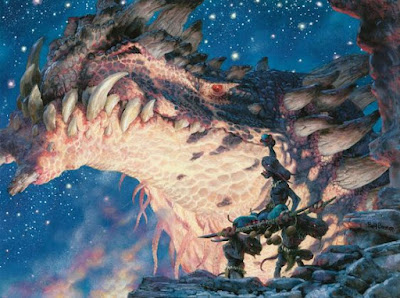
“The White Dragon
Aspects:
- Heat Vision: Great for hunting in the cold north. Smoke and fog are useless.
- Ice Armor: The dragon is covered in layers upon layers of compressed ice. It is incredibly difficult to breach without dealing with it some other way.
- Blizzard Command: The Blizzard is literally serving the dragon like a living thing, it will make firing projectiles at range very difficult.
- Ice Breath: Cold enough to freeze the blood on your veins. Can also launch spears of icy death.
- Flying: It has an edge in maneuverability as long as it is in the air
- Fangs and teeth: It wouldn't take more than a single solid bite to kill you, and don't forget the lethal ice venom
- Lethal Venom: A single bite will freeze you forever.
- Tail Flail: Covered in jagged icicles made of frozen blood”
For major encounters, I would describe them like this. The goal would not be to whittle down the dragon's HP. Instead, I would look to players effectively dealing with all the dragon's abilities. Present a plan that would kill it in the light of its Aspects. Roll for the risky parts of the plan. I was ok with major encounters requiring a bit more back-and-forth, although I got better at limiting it as the game went on. A satisfying combat encounter, to me, is one where players are forced to make hard choices and face significant risk. In addition to the dragon, in this encounter, the player characters had people on the ground and in the air. Those in the air fought the dragon while on the ground, the players faced an approaching Troll hoard and the Icy soldiers of a white witch. She was wheeling in a ballista enchanted to kill the dragon and then raise it as her minion. It was a tricky encounter but the players dealt with it well. Dynamism is important. Pressure is important. If characters have all the time in the world, the sense of danger and urgency just disappears.
You could even “zoom out” on a mystery. This might be tricky, but you can straightforwardly present the pieces of evidence in the same way as you might present a problem.
For example,
“You enter the room of the murdered king and this is the information you gather from the room and from witnesses:
- The door was locked when the King's body was discovered.
- The window is open.
- The king’s veins look dark and swollen.
- His eyes bleed.
- He has a bite on his forearm.
- The room is in shambles as though there was a great struggle.
- There is a piece of paper on the desk and a knocked over quill and ink well. The paper is partially ruined but what you can see appears to be the king refusing to participate in something any further, and a threat to expose “A” if there was any retaliation.
- The king clutches an odd amulet in his hand that looks like a 12 pointed star.
- Servants report having seen a figure in the courtyard moving strangely, as though crawling rather than running. It crawled right over the castle wall to the east.”
The players will have more questions and there might even be more clues hidden but you've given them a solid start to go from and cut down on the back-and-forth.
When wouldn't you “zoom out?"
There were several places that I went against my own advice up above. Back-and-forth was always expected in character conversations. Something this style of play shares with FFR is a love of character roleplay, of diplomacy, of working things out without combat. I think in-character conversations are easy for players to participate in, although your mileage will vary. This is, in many ways, what the game is about. It is about the characters. It is about who they are and what they stand for and what they choose. So I would be reticent to “zoom out’ from social encounters, although you can and perhaps should in some situations.
I also simply refused in some situations because I really liked an idea or wanted to keep up the mystery. Some of the best moments in the game were this way. It really is an art rather than a science. You're going to have to find your balance.
What about the game itself?
Weird Wanderings took around a year of my life. It spanned some of the most difficult times I've ever faced. It outlived my last job. In my worst moments, there was an escape for me into a world of fairies, brave knights, jolly rogues, and dreadful dragons. When I despaired at a world that revolves around crunching numbers, AI nonsense, and scientific cynicism, it was a blessed relief to run away to a world of fairy tales.
It's hard to tell the story of this game because it is many stories. Each player told their own story and they could be drastically different. Maybe I can tell a few and you'll understand.
The Wayward Son
Once upon a time there was a selfish prince, exiled from his father's presence. He had taken to drink and swindling others through guile and charm.
One day he came to a village where the stars dance across the sky and fall. He planned alongside many to enjoy the festivities and then go hunting for fallen stars.
Yet while he was there, he met a beautiful maiden who was bound by a magic silver anklet to a wicked master. She had the bearing of a princess. Her hair was silver, streaked with black. She danced with everything in her in the village square and caught his eye.
The moon spoke to the prince saying, “She is a star, a beloved daughter of mine, set her free and I will reward you.”
The prince attempted to sneak into the wicked man's cart by means of deception, but the man was clever and knocked him unconscious as the stars began to fall.
The prince awakened and wrestled with the man as they hurtled over the hills in pursuit of a fallen star. The prince bested the man and returned the star her heart, and with much of her power restored she gave it up yet again to restore her fallen sibling to the skies.
And so the star woman and the prince rode off together in the cart of the wicked man and had many more adventures together.
The Miracle Worker
Once upon a time, there was a peddler. He made a deal with a demon to give him the power to give miraculous cures but the cures would not last and each cure came with a curse. He went from town to town this way, fleeing one after another before his treachery was discovered.
One day the demon told him, “Go into the city I will show you. It is covered by a great fog and many magicians live there. They make war on the dead who live beyond their walls. Take with you the secret of this elixir which will heal their bodies and make them strong for war. Once you are there, I will tell you more.”
So the peddler set out and arrived at the Shrouded City. He sold his miraculous brew and quickly grew in wealth and status. He discovered all too late that his cure was addictive and those who drank it craved it more and more.
The peddler knew this was disastrous and he tricked the demon, and bound him in a magic candle. The peddler chose to remain in that city and fix what he had broken.
And he had many more adventures there.
The Pale Count
Once upon a time, there was a count who awakened from a great sleep in a crystal coffin. He worked foul magicks, bringing the dead back to life. He came from another world to this one and found it cruel. He turned his back on the Queen of the Moon and chose instead the Empress of Nothing. Even then, he was dissatisfied by the dark powers he gained. Then he sided with a clever prince who sought to trick the dark queen and take her power for himself. This too came to nothing, but the Count grew in power still. Finally, he decided he would turn his terrible might against the magicians of the Shrouded City for they bound fairies, demons, and the spirits of the dead alike in their mad quest for power.
He brought their city to ruin and threw down their great factories before he was slain by a mighty warrior, yet before he died, he burned so very bright.
The Dragonslayer
Once upon a time, there was a king who stole his crown from a mighty dragon. He chose power over love and loyalty and brought ruin to his kingdom at the hands of the Verdigris Queen, whose love he had spurned. She exiled him from his kingdom and he fled to the end of the world where he forgot his name and sins.
He returned to his kingdom hundreds of years later, a humble knight and an aspiring dragon slayer. He slew the green wyrm of the east and set down laws for the wild land it ruled.
He went to the north and slew the white dragon who reigned with ice and blood and gave its kingdom to a fairy who loved him.
He showed mercy to the Verdigris Queen and gave her the forgetfulness he had given himself. He brought low a dread necromancer who came with legions of the dead to destroy a city of his kingdom.
He handed down new laws and forsook power in place of service, remembering who he was and how he had once failed.
He returned to adventure and continued to fight evil for the rest of his days.
There were so many stories that I could tell. I'll beg the forgiveness of my players whose stories I have not told. They live on in my heart regardless.
Procedures
Each Turn, I presented new rumors to the PCs along with some to each PC in particular. They then would choose what they wanted to do. I had a map which I'll show here that they could explore and more lands off the map.
Turns did not have any set amount of time they lasted although the goal was weekly or at least bi-weekly Turns.
This would be their Adventure, a largely self-contained scenario that would interweave with their story and the stories of others.
PCs could also Summon other PCs, such that PCs could be in several places at the same time. This was helpful and let players invite each other to the fun. It got ridiculous when players summoned players who summoned players who summoned players. I gave players two Summons each Turn. This was too many. In my current game, Crownless, I am only allowing one per Turn and you can only be Summoned once per Turn and you can't Summon others to Adventures you've been Summoned too. This is much more manageable.


"My main takeaway from the genre of fantasy especially high fantasy which is steeped deep in the stories of old is that the story always starts in the middle...
ReplyDeleteI am trying to capture that sense of continuity, that sense of stories hiding behind every corner, that the story we will tell with these characters is a story that begins in the middle."
This is a great thesis statement for what you're doing!
I've always enjoyed Weirdways as a system, it's simple and doesn't get in the way, it only does what you need it to do. The Aspects seem a little different than I remember, or maybe they're newer than since the last time we played? A little more like Fate than I remember. But that's a great system too, and it makes sense here.
I sometimes hear about "zooming out" in the context of Factions games, but hadn't thought of it in the context of PbP, but what you're saying makes a lot of sense, and also maybe explains why Factions games are popular for PbP. I like the idea of catering the game to the medium.
I like the fairly tale-style short stories for the characters. Much of the post was more focused on the mechanics, but that brought it back together with the thesis I liked so much at the beginning, and it makes me interested to see the followup post on character creation!
I'm sorry you had such a rough year. There have been times for me as well where TTRPGs and worldbuilding were a valuable coping mechanism. I'm glad to see you posting again and that writing and gaming is helping you.
Thank you much, Max! I'm glad the thesis resonated with you. I think Weird Wanderings started out that way and became more a meditation on the faults of modernity over time because of all the irl stuff going on.
Delete